
Damping clicks explained
Rebound, low-speed and high-speed compression: what each dial does, which way to turn it for which symptom, and how to count clicks so your numbers mean the same thing next year.
Air pressure sets how much force the suspension pushes back with. Damping sets how fast it is allowed to move. Every blue and red dial on a fork or shock is a damping adjuster, and each one only does one thing. Once you know which dial answers which complaint, tuning stops being guesswork.
This guide assumes sag is already right. If it isn’t, start with Suspension setup from scratch. The order that works: sag and air, then rebound, then volume spacers, then compression (low-speed, then high-speed).
What you need
- Your fork and shock’s adjuster list: single or dual compression, single or dual rebound. It’s on the product page or the sticker on the leg. MTB Mate stores it per bike so the setup screen only shows dials you actually have.
- A repeatable test section: a short piece of trail you can ride three times in ten minutes, with braking bumps, one square edge and one corner.
- A way to write clicks down. The setup keeps them next to the pressures.
The dials, one at a time
Rebound — how fast it comes back
Rebound damping slows the suspension’s return after a compression. The most-used dial on the bike, and the one most riders set wrong.
- Too fast (too little damping): the bike pogos after hits, kicks over jumps, the front feels nervous, the rear “bucks” you forward on landings.
- Too slow (too much damping): it can’t recover between consecutive bumps, sinks into its travel and rides low and harsh. Riders often blame compression for this; check rebound first.
Start from the manufacturer’s chart for your pressure. More air pressure needs more rebound damping, which is why the charts are indexed by psi.
Low-speed compression (LSC) — support
Low-speed compression resists slow shaft movements: your body weight shifting, braking dive, pumping, cornering loads, pedalling. “Low speed” is the shaft speed, not how fast you’re riding.
- Too little: the fork dives under braking, the rear squats when you pedal or wallows in berms, the bike feels low in the travel.
- Too much: harsh over small fast chatter, braking bumps and root buzz. This is the most common self-inflicted harshness: riders add support and lose their small-bump grip.
On a single-compression dial, this is the dial.
High-speed compression (HSC) — big hits
High-speed compression resists fast shaft movements: square-edged rocks, drops, landings. It’s on higher-end dampers, sometimes alongside a single rebound dial, and “4-way” means separate low- and high-speed dials for both compression and rebound. The range is short, typically five to eight clicks, so one click is a big step.
- Too little: clunks or blows through the travel on drops and big square hits.
- Too much: deflects off sharp edges instead of absorbing them. This is rare; if a big hit feels harsh, it’s usually spring or LSC first.
High-speed rebound (HSR) — deep travel return
Only on dampers with two rebound dials. Controls how fast the suspension returns after a deep compression, where the spring force is highest. Slow it if the bike bucks on big landings but feels fine on small stuff. Otherwise leave it at the chart setting.
Volume spacers — not a dial, but on the same list
Tokens change the spring curve, making the last part of the travel ramp up. When you’re troubleshooting bottoming, they come after air and a click of HSC; when you never reach full travel with compression open, removing one is the fix. Fitting them means depressurising the air spring and opening it up: follow the service manual for the procedure and the maximum spacer count for your model.
Count clicks from closed
Fox and RockShox print their dials the same way: fully closed (wound in, slowest, firmest) is zero, and you count clicks out from there. MTB Mate always stores clicks from closed. If your manual publishes settings from fully open, as some brands do, convert before you enter them: clicks from closed = total range − clicks from open. Entering a from-open number unconverted silently inverts the setting.
That gives you one rule to remember: a higher number means more open, less damping, softer or faster. When the app proposes “6 → 7 clicks · softer”, the number goes up and the damping goes down. On a 4-way damper with an 18-click rebound range and a 6-click high-speed range, “3 clicks” means very different things per dial, which is why the setup stores each dial’s range from your fork and shock.
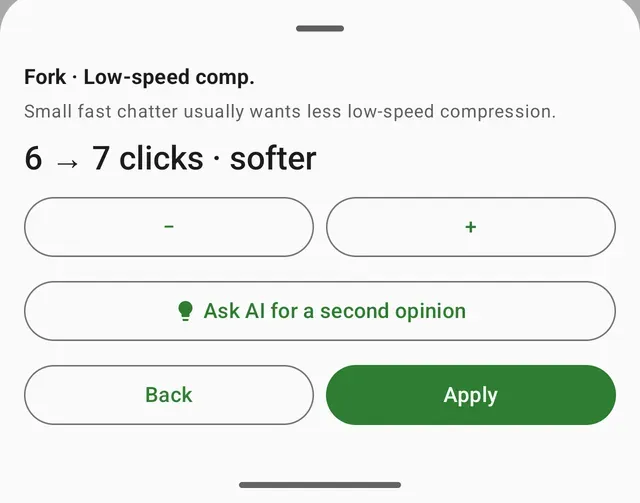 One lever, one direction, one click. The app proposes; you ride and verdict.
The bracketing method
Never turn two dials between test runs. One lever, one step, ride, judge.
- Pick the symptom, then the lever from the table below.
- Move it one step: one click for rebound and high-speed dials, two clicks for low-speed compression, which has a wider range.
- Ride the test section. Better, worse, or no change?
- Better: keep it, and try one more step next run to find the edge. Worse: go back and try the alternative lever in the table. No change: two steps, then reassess.
Write down where you ended up. MTB Mate’s ride-feel loop does exactly this: tap how it felt, say where, apply one change, ride, and the timeline keeps the trail of what worked.
Symptom → dial
| What you feel | Where | First lever | If that doesn’t do it |
|---|---|---|---|
| Harsh, stings on small fast chatter | Fork or shock | LSC less | Air −5 psi fork |
| Harsh on square edges, deflects | Fork | HSC less | Air a touch less, if harsh through the stroke |
| Can’t use full travel, feels like a wall | Fork or shock | Remove a spacer | Air a touch less, then HSC less |
| Dives under braking, wallows in berms, squats when pedalling | Fork (dive) / shock (wallow) | LSC more | Air more if sag is also deep |
| Bottoms out although sag is right | Shock or fork | Air more (~5 psi fork, ~10 psi shock, never above the printed max) | One click more HSC (toward closed), then add a spacer last |
| Bucks, kicks, pogo after hits | Shock or fork | Rebound slower | HSR slower if only on big landings |
| Packs down, rides low and harsh over repeated bumps | Fork or shock | Rebound faster | LSC less, only if still harsh after rebound is right |
Two of these rows are traps worth knowing. “Harsh on big hits” is usually a spring or LSC problem, not a high-speed one, and the loop verifies which way. “Bottoms out” is a spring shortfall first: more air, one click more HSC, and only then a token.
Cold days
Damper oil thickens as it cools, and the worst fluids are many times thicker at freezing than at summer temperatures. The same clicks feel harsher on a cold morning. Open low-speed compression one step (two clicks), and speed rebound a click if it packs down in the cold. Put the clicks back when the weather does. Enter the temperature in MTB Mate and it nudges the same way for you.
Quick reference
| Dial | Resists | Too little | Too much |
|---|---|---|---|
| Rebound | Return speed | Pogo, bucking | Packs down, rides low |
| LSC | Body weight, braking, pumping | Dive, wallow, squat | Small-bump harshness |
| HSC | Square edges, landings | Blows through on drops | Deflects off edges (rare) |
| HSR | Return after deep compression | Bucks on big landings | Dead feel off big hits |
| Spacers | End-stroke ramp | Bottoms out | Can’t reach full travel |
Clicks are counted from closed. Higher number, more open, softer. Everything else is one step at a time.